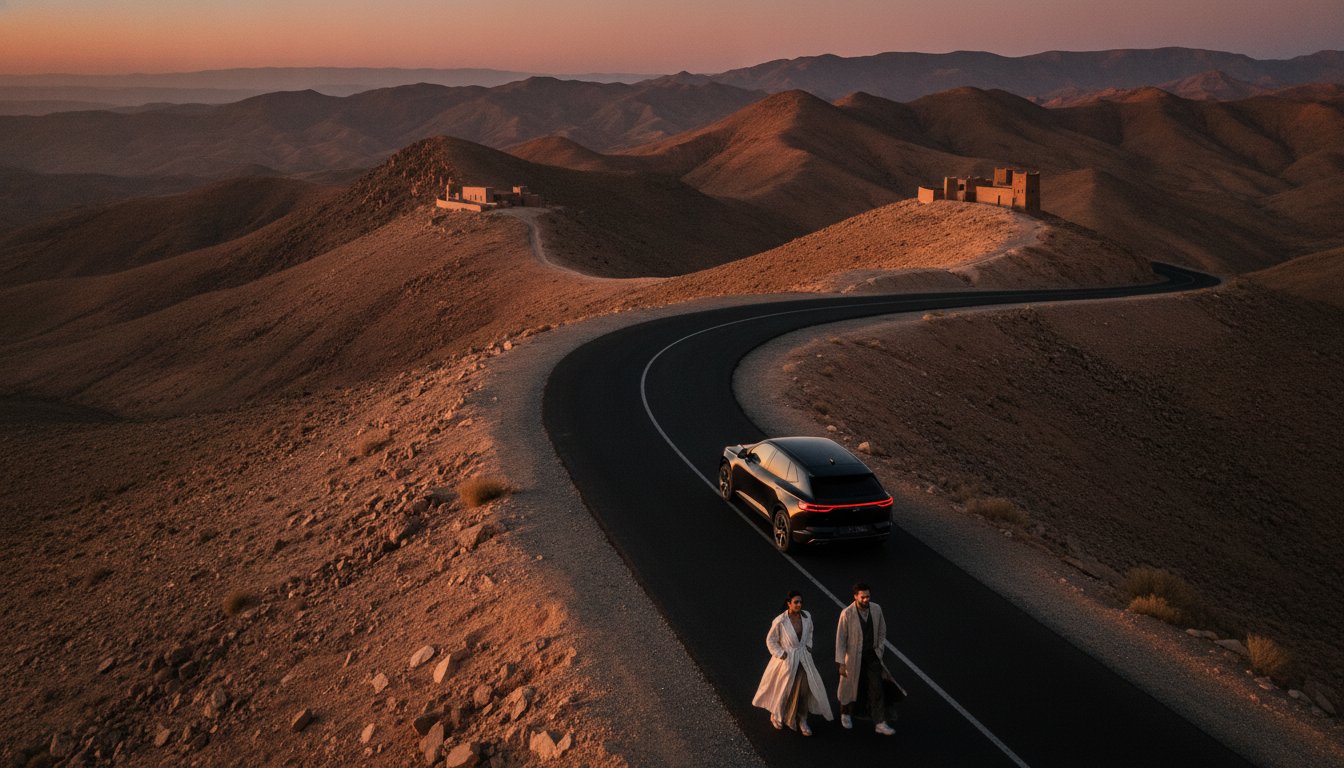
You don't need to lock away a massive security deposit just to see the sunset over the Merzouga dunes. Most travelers dread the rental counter, fearing hidden fees and the stress of navigating local police checkpoints. Driving in Morocco for tourists used to feel like a high-stakes gamble, but in 2026, the digital-first approach has replaced old-school bureaucracy with total transparency. It’s about freedom, not paperwork.
We know the typical pain points: the confusion over International Driving Permits and the anxiety of local traffic culture. This guide helps you master the process of renting a car in Morocco with a clear look at requirements, no-deposit options, and local etiquette. You’ll gain a stress-free booking experience and the confidence to navigate national roads independently. We’re covering the essential document checklist, how to avoid common scams, and how to handle everything from High Atlas mountain passes to urban roundabouts like a local insider. Your road trip should be about the journey, not the fine print.
Key Takeaways
- Learn why modern infrastructure makes driving in Morocco for tourists safer and more rewarding than relying on public transport.
- Get the definitive checklist for essential documents, including why an International Driving Permit is your best friend on the road.
- Discover how to avoid high credit card holds by choosing digital-first platforms that offer no-deposit rental options.
- Master local driving etiquette to navigate police checkpoints and fuel stations with the confidence of a local expert.
- Follow our step-by-step guide to secure an instant booking with zero hidden fees before you even land.
Is Driving in Morocco for Tourists Safe and Worth It?
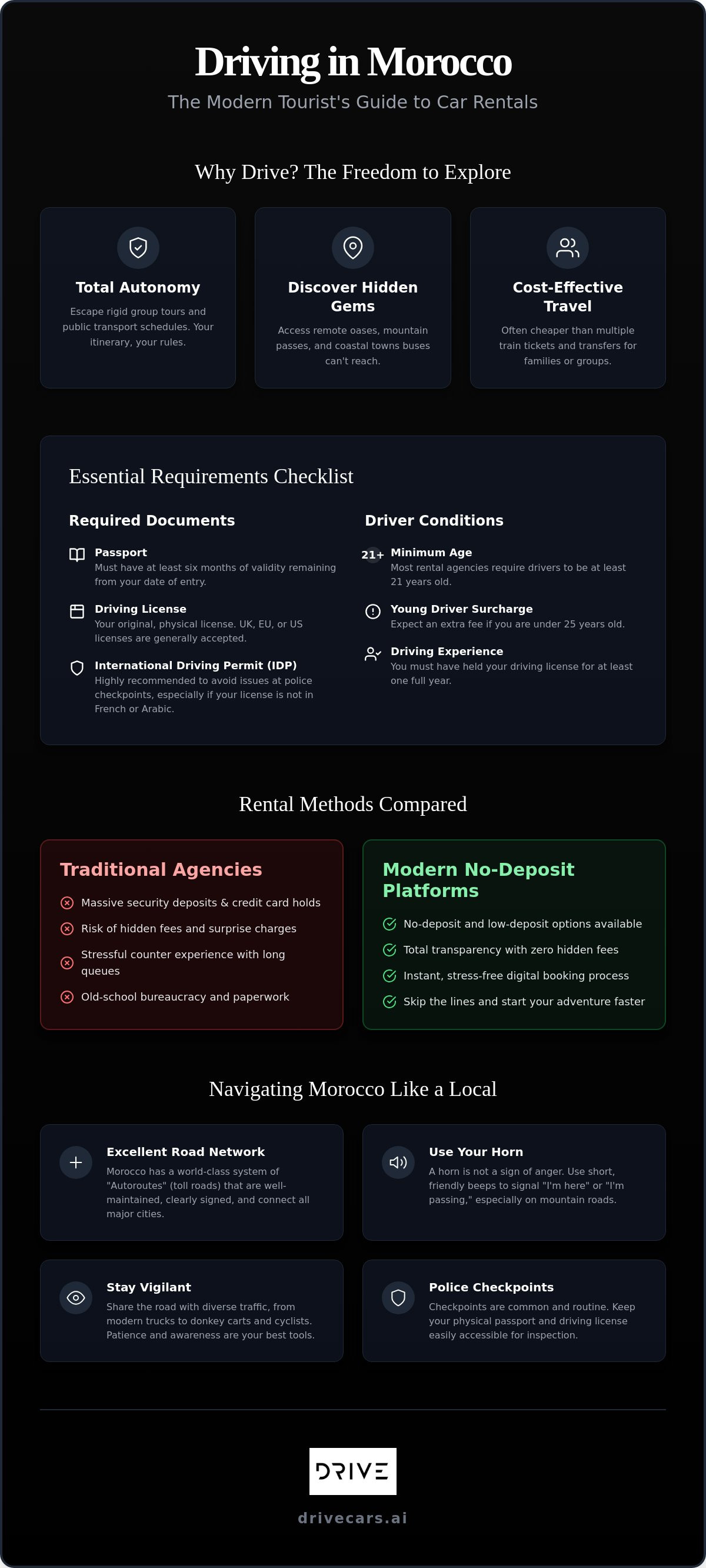
Public transport in Morocco is reliable between major hubs, but it puts your schedule in someone else's hands. Trains and buses won't take you to the hidden palm groves of the Skoura Oasis or the winding cliffside roads of the Dades Valley. If you want to see the real Morocco, you need four wheels and a map. Driving in Morocco for tourists offers a level of autonomy that group tours simply can't match. It’s the difference between seeing the country through a window and actually experiencing the landscape.
Safety is the first question every traveler asks. While city centers like Casablanca or Marrakech feel like a high-speed puzzle, the reality is more about rhythm than risk. It’s hectic, not dangerous. Once you clear the city limits, the open road is yours. For groups or families, an SUV Rental or a Sedan Rental often proves more cost-effective than booking multiple train tickets and private transfers, especially when you factor in the value of your time.
To better understand the reality of hitting the road, watch this helpful video from a traveler's perspective:
Choosing to drive yourself means you own your itinerary. You can chase the light for photography or stay an extra hour at a roadside cafe. Driving in Morocco for tourists is now more accessible than ever, thanks to digital platforms that prioritize transparency over old-school rental counter stress. You get the keys, skip the lines, and start your adventure on your own terms.
The National Infrastructure Advantage
Morocco has poured billions into its road network over the last decade. Morocco's transportation infrastructure now features a world-class system of "Autoroutes" (toll roads) that connect Tangier to Agadir. These highways are well-maintained, clearly signed, and surprisingly empty outside of peak hours. If you're heading into the mountains, an SUV Rental provides the clearance you need for rural tracks, while an Economy Car Rental is perfect for zipping between coastal towns. National roads are generally safe and well-engineered for international drivers.
Cultural Driving Etiquette
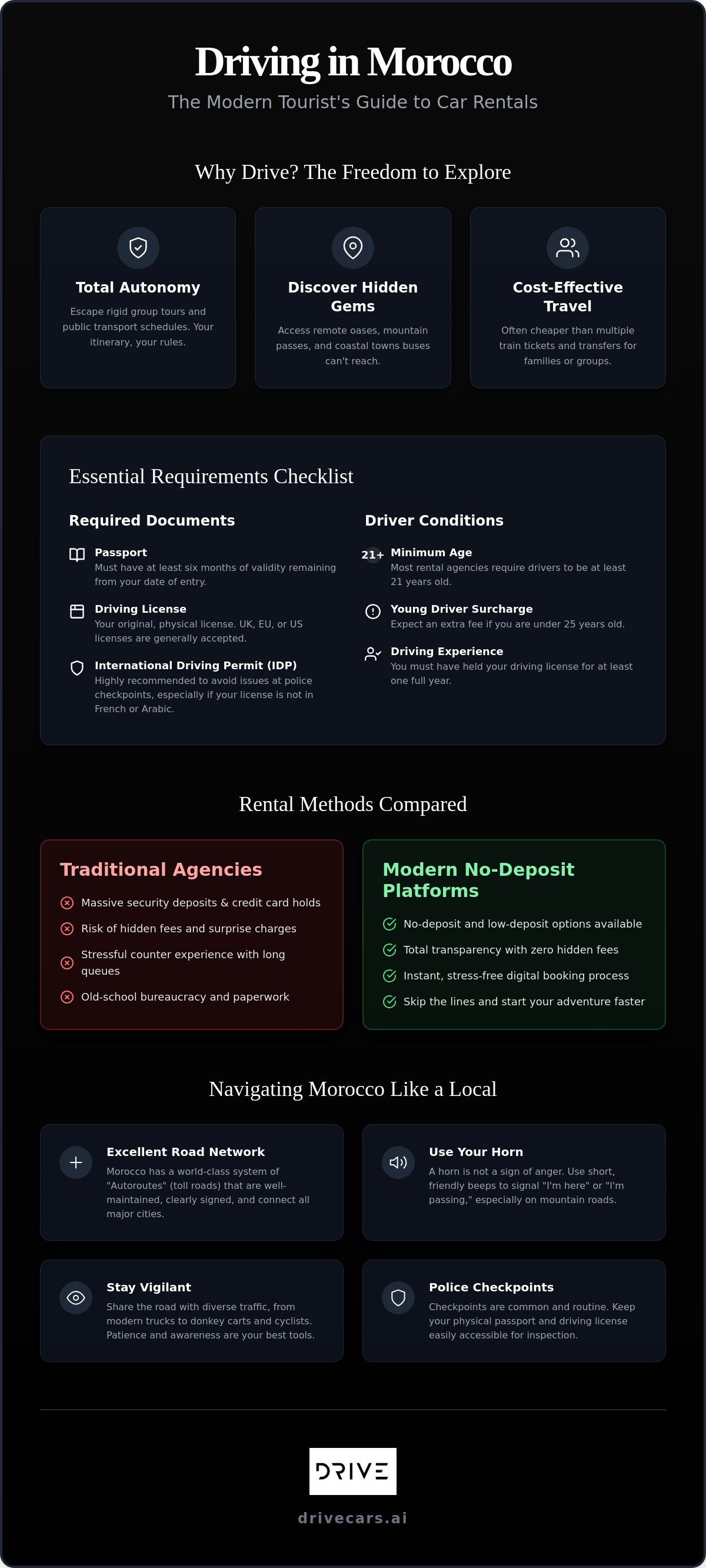
Understanding the local flow is better than knowing every technical rule. In Morocco, the "right of way" is often a negotiation; larger vehicles or those already in a maneuver tend to take priority. The horn isn't a sign of anger here. It’s a friendly "I'm here" or "I'm passing you." Use it to communicate with trucks on mountain passes or to alert pedestrians in busy souk areas. Vigilance is key on national roads because you’ll share the space with everything from modern sedans to donkey carts and cyclists. Stay alert, stay patient, and you’ll fit right in.
Essential Requirements: What You Need to Rent a Car in Morocco
You can't just land and grab the keys without a plan. While the process is getting faster, Moroccan law and rental agencies still require a specific set of credentials. Driving in Morocco for tourists is straightforward if you arrive prepared. If you don't, you might find yourself stuck at the airport terminal instead of cruising the coast.
Your standard domestic driving license from the UK, EU, or US is generally accepted for short-term visits. However, there's a catch. If your license isn't in French, English, or Arabic, you'll need an International Driving Permit (IDP). Even if your license is in English, we always recommend carrying an IDP. It acts as a standardized translation that local authorities recognize instantly during routine checks. It's a small document that prevents big headaches.
Age is the next hurdle. While you can legally drive at 18 in Morocco, most rental companies won't hand over a Luxury Car Rental or even a basic Economy Car Rental unless you're at least 21. Many agencies also apply a "young driver" surcharge for anyone under 25. You also need to have held your license for at least one full year. Check these details before you book to avoid surprise fees at the pickup point.
The Paperwork Checklist
Digital copies won't cut it here. You must carry your physical, original driving license at all times. Local police checkpoints are common, and they will ask to see the hard copy along with your passport. Your passport should have at least six months of validity remaining from your date of entry. This is standard official travel and safety information that applies to all visitors. Keep these documents in a secure but accessible place in the car. You can learn more about our transparent rental process to see how we handle these requirements digitally to save you time.
Insurance and Liability
Every rental includes basic third-party liability insurance by law. This covers damage to others, but it leaves you vulnerable for the car itself. We strongly suggest opting for a Collision Damage Waiver (CDW). This limits your financial exposure if the vehicle is damaged or stolen. The biggest shift in 2026 is the rise of no-deposit platforms. Traditional agencies often block thousands of dirhams on your credit card as a security hold. Choosing a no-deposit option removes this friction entirely, giving you more liquid cash for your trip while keeping you fully protected. It’s a smarter way to manage your travel budget. If you're ready to start your journey, browse our available fleet to find the right fit for your itinerary.
Traditional Agencies vs. Modern No-Deposit Platforms
Traditional rental counters are quickly becoming relics of a slower era. They often feel like a hurdle rather than a service. For years, the standard advice for driving in Morocco for tourists involved bracing for long queues and aggressive insurance upsells at the airport. Modern digital platforms have flipped this script. By moving the entire booking process online, travelers can bypass the "airport tax" and hidden surcharges that often plague traditional storefronts. It is about moving from a transaction to a shared experience.
The "credit card trap" is perhaps the biggest pain point of the old-school model. Traditional agencies almost always require a significant security hold, often locking away hundreds or even thousands of dollars. This can tie up a large portion of your travel budget for weeks after you return home. It’s a friction point that makes many savvy travelers hesitate. Modern platforms bridge the gap between local car owners and international visitors. They offer a more communal approach that prioritizes digital trust over massive financial barriers.
Why No-Deposit Rentals are the Best Choice for Tourists
Choosing a no-deposit option is fundamentally about financial freedom. You keep your funds available for experiences like guided tours in Fes or luxury stays in the Sahara. It also solves the problem for travelers who don't carry high-limit credit cards or prefer using debit cards. These platforms use advanced digital verification and comprehensive insurance structures to protect both the owner and the driver. It’s a tech-forward solution that treats you like a guest, not a liability. If you have questions about how this works for your specific route, you can contact us for national support at any time.
Transparency is the hallmark of a digital-first platform. You see the total cost upfront, including any necessary insurance. Practical tips for driving in Morocco often emphasize the need for clear communication, and that starts with the booking process. Having access to 24/7 support in six languages provides a vital safety net. Whether you’re navigating a flat tire or just need help with directions, knowing an expert is a tap away changes the entire driving in Morocco for tourists experience. It replaces anxiety with "cool efficiency."
Airport vs. City Pickup Logistics
Efficiency is everything when you land. Airport car delivery means your vehicle is waiting for you near the arrivals gate, skipping the cramped shuttle bus to a remote rental lot. Flexibility is equally important for the modern nomad. Travel plans can shift, so look for platforms that offer free cancellation up to 24 hours before your trip begins. This ensures your road trip remains a source of joy rather than a logistical burden. You get the keys, you get the freedom, and you get moving without the traditional industry stiffness.
How to Rent a Car in Morocco: A Step-by-Step Tourist Guide
Forget the outdated advice of haggling at a physical counter. It’s slow, risky, and often leads to hidden fees. For a seamless experience with driving in Morocco for tourists, your journey starts on your phone. Digital platforms have replaced the stress of the rental lot with a streamlined, transparent workflow that puts you in control before you even pack your bags.
- Step 1: Browse and compare. Use our digital platform to filter by vehicle type. Compare an Economy Car Rental for city hops against an SUV Rental for the High Atlas.
- Step 2: Secure your booking. Get instant confirmation. Our system ensures the price you see is the price you pay, with no surprise "airport fees" added later.
- Step 3: Coordinate logistics. Choose Airport Car Delivery to have your vehicle waiting at arrivals. It bypasses the shuttle bus and the terminal queues.
- Step 4: Inspect and document. Conduct a 360-degree walkaround. Take a quick video of the car’s exterior and interior to document its condition.
- Step 5: Review support protocols. Save the 24/7 multilingual support number. Confirm you know how to reach an expert if you need help with directions or roadside assistance.
This structured approach removes the guesswork. You move from the plane to the open road in minutes. If you're ready to pick your vehicle, start your instant car search now to see what's available for your dates.
Choosing the Right Vehicle for Your Route
Your itinerary dictates your fleet choice. Economy hatchbacks are the gold standard for fuel efficiency on the long, flat stretches between Casablanca and Agadir. They’re easy to park in crowded city centers and handle the modern toll roads with ease. If your heart is set on the mountain passes or the fringes of the Sahara, an SUV Rental is necessary for the extra ground clearance. For a deeper dive into smaller vehicles, read The Ultimate Guide to Economy Car Rental in Morocco (2026).
The Pickup Protocol
Don't rush the handoff. Check the air conditioning immediately; it’s a vital comfort feature in the Moroccan heat. Test the spare wheel and ensure the jack is present in the trunk. Review your rental agreement to confirm that your Collision Damage Waiver and third-party liability are clearly stated. Our free cancellation policy up to 24 hours before pickup gives you total flexibility if your travel plans change at the last minute. This safety net ensures you never pay for a car you can't use. Once you’re satisfied, sign the digital form and start your engine.
On the Road: Practical Tips for Navigating Morocco
Hitting the highway is where the real adventure begins. Driving in Morocco for tourists is an exercise in awareness and rhythm. You've secured your Economy Car Rental or SUV Rental; now you need to master the local flow. The roads are yours, but the rules are specific. Understanding the nuances of checkpoints and local parking saves you time and keeps your travel budget intact.
Speed enforcement is strict in 2026. Moroccan authorities have significantly increased the use of both fixed and mobile speed cameras. You'll find them on major motorways and even on quiet rural stretches. Stick to the limits: 120 km/h on motorways, 100 km/h on open roads, and 40 to 60 km/h in urban zones. Fines are typically paid on the spot in cash, and officers will provide an official receipt. A minor slip of 10 to 20 km/h over the limit will cost you 700 MAD. Stay focused and keep your eyes on the signs.
Checkpoints and Road Safety
Police checkpoints are a standard part of the Moroccan landscape. They aren't there to hassle you; they're for national security and traffic safety. When you see a checkpoint sign, slow down significantly. Don't stop completely until the officer signals you forward with a hand gesture or a whistle. Have your passport, driving license, and rental contract ready. If you're following the Car Rental Morocco Tips for Tourists: The 2026 Insider Guide, you'll already have these in an accessible folder. Be polite, stay calm, and you'll be back on your way in seconds.
Safety extends to your tech use. Using a mobile phone while driving carries a 700 MAD fine. Seatbelts are mandatory for everyone in the vehicle; failing to wear one costs 300 MAD. Most importantly, Morocco has a strict zero-tolerance (0.0%) alcohol limit for drivers. It’s simple: if you drink, don't drive.
Fuel and Parking Logistics
Fueling up requires knowing the terminology. "Sans Plomb" is unleaded gasoline, currently priced around 13.85 MAD per liter. "Gasoil" is diesel, which is slightly cheaper at 12.60 MAD per liter. Most rental fleets in Morocco, especially for long-distance travel, run on diesel. Always double-check the sticker inside the fuel cap before the attendant starts the pump. Gas stations are frequent on national highways, but they become sparse in the High Atlas or desert regions. Refill whenever your tank hits the halfway mark in rural areas.
Parking in cities introduces you to the "Gardiens." These attendants, often wearing yellow or blue vests, manage street parking. They don't work for the city, but they are a recognized part of the local ecosystem. They keep an eye on your car and help you navigate tight spots. In 2026, the standard rate for day parking is 5 to 10 MAD. If you're leaving the car overnight, 20 MAD is appropriate. For more detailed route planning, check out our pillar guide on Driving in Morocco: The Ultimate 2026 Car Rental & Road Trip Guide. It covers everything you need for a successful national journey.
Claim Your Freedom on the Open Road
The days of navigating confusing contracts and high security holds are over. You've learned that driving in Morocco for tourists is now about digital efficiency and local expertise. With modern infrastructure connecting the coast to the mountains, the only thing left is to choose your path. You have the document checklist, the insider tips for checkpoints, and the knowledge to avoid the traditional credit card trap. Morocco is best experienced at your own pace, stopping for the views that group tours miss.
Ready to hit the road? Experience a smoother journey with a platform built for the modern traveler. We offer a no credit card required booking process and 24/7 multilingual support in six languages to keep you moving. Plus, our free cancellation up to 24h before pickup ensures your plans stay as flexible as your itinerary. Book Your No-Deposit Car Rental in Morocco Today and start your adventure. The open road is calling; it’s time to answer.
Frequently Asked Questions
Can I drive in Morocco with a UK or US driving license?
Yes, you can use your original UK or US license for up to one year as a tourist. An International Driving Permit (IDP) is strongly recommended for driving in Morocco for tourists. It provides a standardized translation that local police and rental agencies recognize instantly. Carrying both documents ensures you pass through routine checkpoints without any language barriers or administrative delays. It’s a simple step for a much smoother trip.
Is it safe for tourists to drive in Morocco at night?
It’s much safer to avoid driving at night on rural or national roads. Many stretches lack proper lighting, and you might encounter pedestrians, livestock, or unlit vehicles on the road. Stick to daytime travel for your long-distance routes to ensure maximum visibility and safety. If you must drive after dark, keep your speed low and stay within well-lit urban centers where road conditions are more predictable and traffic is more organized.
How much is the average cost of car rental in Morocco for a week?
Market rates fluctuate based on the season and the specific vehicle class you choose. During the high season between June and August, prices naturally climb due to high demand. Industry data shows that small economy cars generally range from 150 to 200 Moroccan Dirhams per day. If you need more space, an SUV Rental will cost more, but it offers better comfort for longer national road trips across the country’s diverse landscapes.
What happens if I get a speeding fine in a Moroccan rental car?
You must pay on-the-spot fines in cash using Moroccan Dirhams if an officer stops you for a violation. A common fine for minor speeding, such as going 10 to 20 km/h over the limit, is 700 MAD. Always demand an official receipt for any payment made to authorities. If a fixed radar camera catches you, the rental agency will usually process the fine and charge your saved payment method, often adding a small administrative fee.
Do I need a 4x4 or SUV for a standard Morocco road trip?
A standard 4x4 isn't necessary for the main highways between major cities like Casablanca and Marrakech. Morocco’s toll roads are world-class and well-maintained. However, an SUV Rental is a smart choice if you plan to explore the High Atlas mountains or rural desert fringes. The extra ground clearance makes navigating uneven terrain much easier and provides a more commanding view of the stunning scenery while you travel between regions.
Is car rental insurance mandatory for tourists in Morocco?
Third-party liability insurance is mandatory by law and is included in every rental contract. While this covers damage to others, we strongly recommend adding a Collision Damage Waiver (CDW) for extra peace of mind. It protects you from high out-of-pocket costs if the vehicle is damaged or stolen during your trip. Check your rental agreement before signing to ensure the coverage details are transparent and meet your specific protection needs for the road.
Can I rent a car in Morocco without a credit card?
You can definitely rent a car without a credit card by choosing modern digital-first platforms. These services frequently accept debit cards and offer no-deposit rentals for driving in Morocco for tourists. This approach keeps your travel funds liquid and available for experiences instead of being locked in a massive security hold. It’s a faster, more transparent way to get behind the wheel without the traditional banking friction often found at airport counters.
Are there many toll roads in Morocco and how do I pay?
Toll roads are common and connect most major regions, including the primary route from Tangier to Agadir. You can pay with cash in Moroccan Dirhams or a credit card at the booths. For example, the trip from Casablanca to Rabat costs approximately 23 MAD for a standard passenger car. These "Autoroutes" are the fastest way to travel, offering well-maintained surfaces and clear signage that makes navigation easy for international drivers.