A single misunderstood stop sign shouldn't be the reason your Moroccan road trip hits a snag. While the blend of Arabic, French, and Tamazight script looks intimidating, the logic behind the road network is surprisingly streamlined. You likely want to explore the coast and the mountains without the constant fear of a 700 MAD fine or a confusing encounter at a Gendarmerie checkpoint. It's completely normal to feel a bit of "signage stress" when you're steering a rental car through unfamiliar territory.
This 2026 reference guide is your shortcut to total clarity. We've simplified the complex world of Morocco road signs for tourists into a visual and linguistic toolkit that builds your confidence instantly. You'll learn exactly how to react to police signals, recognize updated black and white regulatory icons, and navigate roundabouts with ease. From understanding the zero tolerance 0.0% blood alcohol limit to mastering the 120 km/h highway flow, we're giving you the insider knowledge needed to drive like a savvy local. Get ready to hit the national roads with zero hesitation.
Key Takeaways
- Navigate with ease by understanding how Morocco aligns with international Vienna Convention standards and uses bilingual signage.
- Identify critical Morocco road signs for tourists, from the "Qif" stop sign to the specific colors used for updated speed limit regulations.
- Master the "Halte" checkpoint protocol to interact confidently with the Gendarmerie without slowing your journey.
- Stay alert for unique warning signs, including legally binding livestock alerts and high-visibility pedestrian zones near markets.
- Prepare for the road with a checklist of mandatory physical documents and smart offline navigation strategies.
Understanding the Basics of Morocco Road Signs in 2026
Driving in Morocco is surprisingly intuitive. The kingdom adheres to the Vienna Convention on Road Signs and Signals. This international framework ensures the visual language you see on the streets of Marrakech is the same as what you’d find in Paris or Madrid. Whether you're navigating a bustling city center or a quiet mountain pass, the signage remains consistent and reliable. For a deep dive into specific designs, you can consult a comprehensive guide to road signs in Morocco to see how these standards are applied locally.
You don't need to be a linguist to master the roads here. Morocco road signs for tourists rely heavily on standardized symbols. These icons do the heavy lifting, allowing you to identify hazards or services at a glance. It's a system built for speed and clarity. While the text provides extra detail, the shape and color of the sign give you the most critical information first. This makes the driving experience feel modern and efficient from the moment you leave the airport.
To better understand the visual flow of the Moroccan road network, watch this helpful video:
The Bilingual Layout: Arabic and French
Morocco uses a dual-language system that prioritizes clarity for both locals and international visitors. Most signs feature Modern Standard Arabic script at the top or on the right side. French translations sit directly below or to the left. This bilingual standard is applied across all national Moroccan highways and major urban routes to provide a seamless navigation experience. You'll rarely find a major regulatory sign that doesn't offer a French equivalent, making it easy to cross-reference with your GPS or map.
Standardised Shapes and Their Meanings
The geometry of the signs is your primary guide. Learning three basic shapes lets you anticipate almost every rule on the road. The system triggers an immediate reaction, helping you stay safe without overthinking.
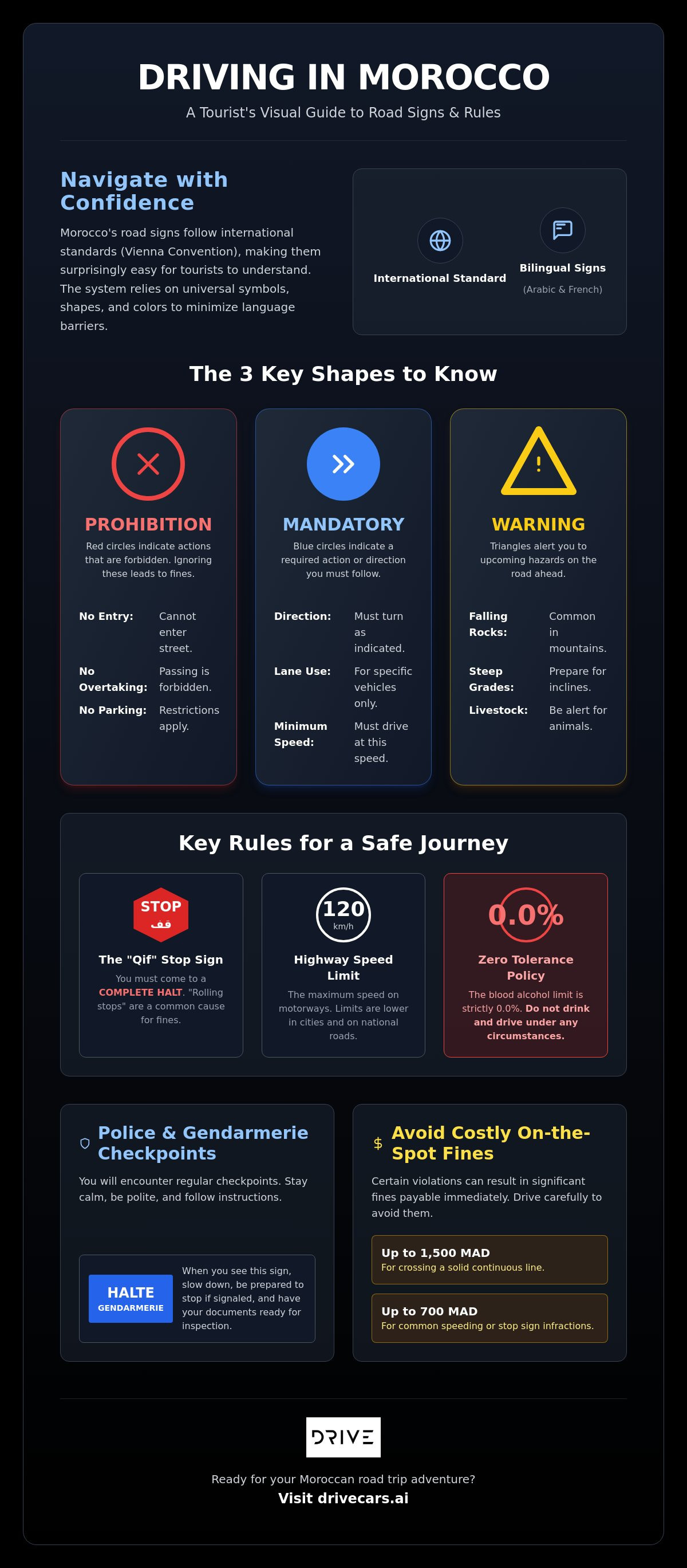
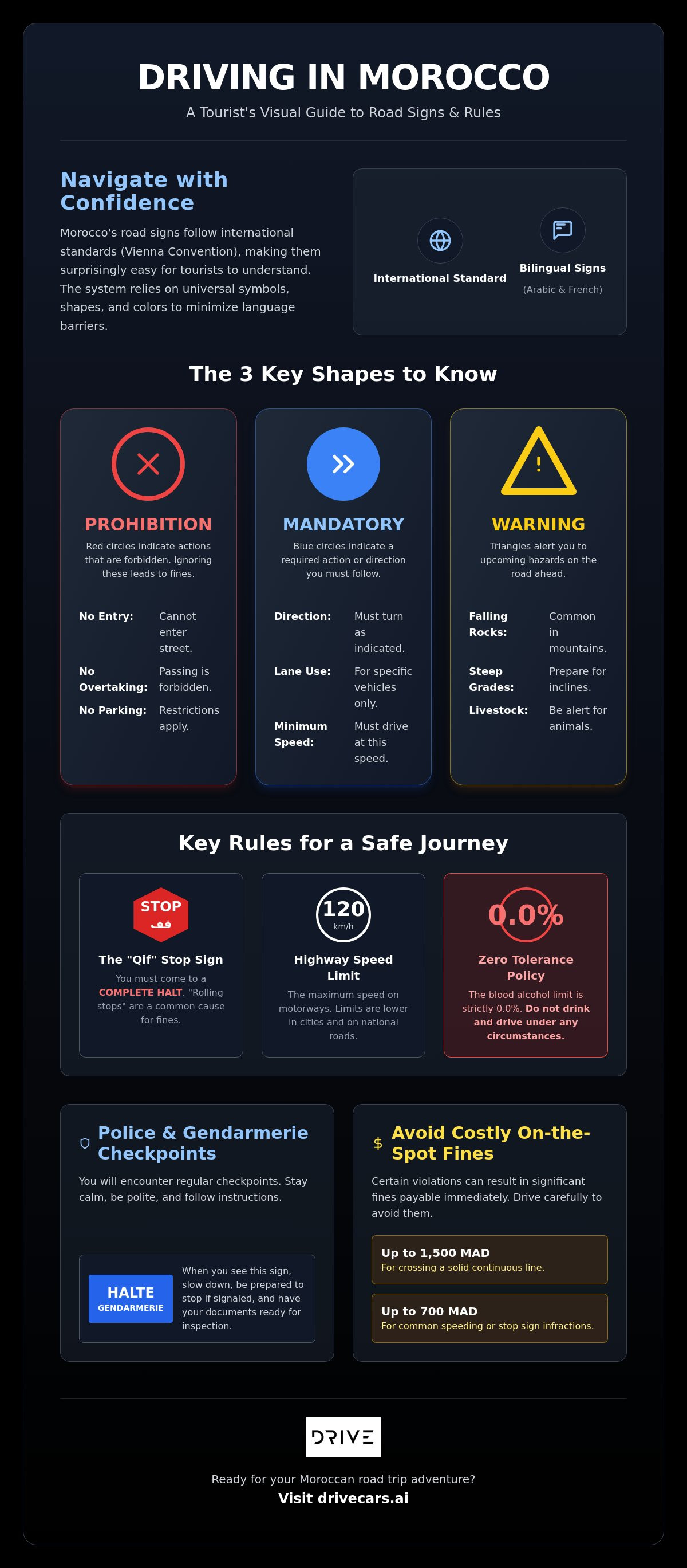
- Red circles: These represent mandatory prohibitions. They are non-negotiable rules. If you see a red-bordered circle, it's telling you exactly what is forbidden to avoid dangerous situations and heavy fines.
- Blue circles: These indicate positive instructions. They show mandatory directions, such as "Turn Right Only," or lanes reserved for specific vehicle types. Follow these to stay within the legal flow of traffic.
- Yellow or white triangles: These are classic warning signs. They alert you to upcoming road hazards like falling rocks, steep grades, or sudden merges. A 2019 decree updated many of these to use high-contrast black symbols for better visibility.
By focusing on these shapes, you'll find that Morocco road signs for tourists are remarkably easy to decode. The combination of international symbols and bilingual text removes the friction from your journey. It lets you focus on the scenery rather than worrying about a missed instruction. Standardised symbols allow tourists to navigate safely even without reading Arabic or French.
Regulatory Signs: Essential Rules for Every Tourist
Mastering Morocco road signs for tourists starts with recognizing the red circle. These are regulatory signs. They tell you exactly what you must do, or more importantly, what you cannot do. Missing one isn't just a safety risk; it's a fast track to a fine. For instance, crossing a continuous line can cost you 1,500 MAD on the spot. The logic is simple: red means stop or "don't."
The most recognizable sign is the stop sign. It features the word "STOP" in Latin script and "قف" (Qif) in Arabic. You must come to a complete halt at these intersections. A "rolling stop" is a frequent reason for police intervention. Other critical prohibitions you'll encounter include:
- No Entry: A solid red circle with a white horizontal bar. You'll see these often at the exits of one-way streets in city centers.
- Overtaking Prohibited: Two cars side-by-side inside a red circle. This is common on narrow national roads where visibility is limited or curves are sharp.
- Parking Restrictions: Blue circles with a single red slash indicate restricted or paid parking. A blue circle with a red "X" means no stopping or parking under any circumstances.
For a broader look at traffic culture and local right-of-way rules, the International Drivers Association guide provides excellent context for foreign drivers. Understanding these nuances helps you blend in and drive with the "cool efficiency" that defines the local flow.
Speed Limits and End-of-Restriction Signs
Speed enforcement is aggressive in Morocco. Expect frequent mobile radar traps and fixed cameras on major routes between Casablanca and Marrakech. Urban areas are strictly limited to 40 or 50 km/h. Rural and national roads usually allow for 80 to 100 km/h, while the highways (Autoroutes) permit 120 km/h. Watch for the "End of Restriction" sign; it's a white or grey circle with a black diagonal slash. This sign cancels previous speed limits and returns you to the default road speed. If you want to tackle long national stretches with ease, choosing a luxury car rental ensures you have the power and comfort to handle these transitions smoothly.
Mandatory Direction and Lane Signs
Blue circular signs provide positive instructions. A blue circle with a white arrow means you must follow that specific direction. These are vital in dense city centers where one-way systems are the norm. Roundabouts also have their own logic. In Morocco, priority is given to vehicles already inside the roundabout. You must yield to traffic coming from your left unless a specific sign or officer indicates otherwise. Always look for the blue circular icon with three rotating arrows before entering any major intersection.
Warning and Information Signs: Hazards to Watch For
Warning signs in Morocco use the classic triangular shape. They alert you to shifts in the environment before they become problems. Unlike regulatory signs that tell you what to do, these prepare you for what's ahead. Paying attention to these Morocco road signs for tourists is the difference between a smooth ride and a stressful detour. Most warnings feature a red border with a white or yellow background, highlighting immediate risks like sharp bends or slippery surfaces.
Color coding is your best friend for long-distance navigation. It tells you exactly what type of road you're on without needing a map. Green signs indicate you're on the "Autoroute" (motorway) system. Blue signs mark national roads, which are generally well-maintained but slower. White signs guide you toward local routes and smaller villages. Look for high-visibility yellow backgrounds for temporary road work. These indicate construction zones or detours that require extra caution and a significant drop in speed.
Unique Moroccan Road Hazards
Don't treat animal crossing signs as mere tourist novelties. Icons featuring camels, donkeys, or sheep are legally binding warnings. If an accident occurs in a zone marked with these signs, the driver is often held liable for damages to the livestock. Slow down immediately when you see these. You'll also encounter narrow road warnings in the Rif or Atlas Mountains. These indicate stretches where two vehicles cannot pass simultaneously. In 2026, many of these mountain passes also feature steep gradient signs. They help you manage your brakes and engine cooling during long descents.
Navigating with Informational Signs
Tracking your progress is easy with traditional kilometre stones. These small markers sit on the roadside, showing the distance to the next major town. They're incredibly reliable when digital signals drop. Service signs are just as intuitive. They use standardized icons for fuel stations, cafes, and prayer rooms. Most service areas are spaced every 40 to 60 km on major highways. For emergencies, look for the hospital "H" icon or the red crescent. These markers ensure you can find help quickly, even in unfamiliar territory. Mastering these Morocco road signs for tourists ensures you stay ahead of the curve, especially when navigating the diverse landscapes of the Sahara or the High Atlas. If you're planning a rugged mountain route, an SUV rental provides the durability needed to handle these diverse terrains safely.
Deciphering Police and Gendarmerie Checkpoint Signs
Encountering a checkpoint is a standard part of the Moroccan driving experience. You'll find them at city entrances, near toll booths, and along major national highways. The most important Morocco road signs for tourists to recognize are the "Halte" signs. These circular, red-bordered markers feature bold text reading "HALTE POLICE" or "HALTE GENDARMERIE." They aren't meant to intimidate you. Instead, they facilitate safety and security across the kingdom. Recognizing the "Gendarmerie Royale" (الدرك الملكي) script on the signage helps you identify these official stops from a distance. These officers typically wear royal blue uniforms and manage traffic outside of major metropolitan areas.
Fixed checkpoints are permanent fixtures that remain in the same location for years. Mobile checkpoints are more fluid, often appearing on rural roads or near specific intersections. Regardless of the type, the signage remains your primary guide. While local drivers might seem to breeze through, tourists often panic and slam on the brakes unexpectedly. This is unnecessary and can be dangerous for drivers behind you. Understanding the visual cues keeps the traffic flow efficient and your stress levels low as you navigate between cities.
The "Halte" Protocol for Tourists
Approach every checkpoint at a walking pace, typically between 10 and 20 km/h. Keep your hands visible and roll down your driver-side window slightly as you get closer. Make direct eye contact with the officer on duty. In most cases, they will give you a quick hand gesture or a wave to proceed without stopping. A full stop is only required if the officer explicitly signals you to pull over. If they do signal you, stay calm and have your rental documents and passport ready for a quick inspection. Most officers are helpful and will have you back on the road in minutes.
Security and Customs Signage
Speed enforcement is often preceded by "Contrôle Radar" signs. These alert you to fixed or mobile speed camera zones ahead. Morocco has increased its use of automated radar systems significantly since 2023, so take these warnings seriously. If you see a "Douane" sign, you're approaching a customs zone. These are common near major ports like Tangier Med or in specific southern regions. City police handle urban traffic, while the Gendarmerie Royale manages national roads. Both use the same "Halte" sign logic, so your reaction should remain consistent throughout your trip. To ensure you're driving a vehicle that meets all local safety standards, book a SUV rental for your next cross-country adventure.
Practical Tips for a Stress-Free Moroccan Road Trip
Knowledge of Morocco road signs for tourists is only half the battle. Real-world preparation ensures your journey remains smooth from Tangier to the dunes of Merzouga. Always keep your physical driving license and rental agreement within arm's reach. While digital life is convenient, Moroccan officers require hard copies during inspections. If your license isn't in French, English, or Arabic, remember that an International Driving Permit is mandatory. It's a small detail that prevents major delays and ensures you're fully compliant with local regulations.
Tech is your best backup. Download offline maps before heading into the rural hinterlands. GPS signals can vanish in deep mountain valleys, leaving you reliant on physical signage and kilometre stones. Another pro tip: observe local drivers. If you notice a sudden, collective drop in speed among local plates, there's likely a mobile radar or a "Halte" sign you haven't spotted yet. Trust their local instincts to stay within the legal limits and avoid those 700 MAD speeding fines. Efficiency on the road often comes from watching those who know it best.
Choosing the Right Vehicle for Moroccan Roads
Your vehicle choice defines your experience. Compact economy hatchbacks are perfect for weaving through the tight perimeters of the Marrakech Medina. However, if you're planning to cross the Tizi n'Tichka pass, an SUV rental offers the ground clearance and stability you'll want for those steep gradients. DriveCars.ai simplifies the entire process by offering no-deposit rentals for international travellers. This removes the financial friction often found with traditional agencies. Learn more about our economy car rental options in Morocco to find your perfect match for city or coastal driving.
Support and Safety on the Road
Flexibility is key to a modern road trip. Our platform provides instant booking and free cancellation, giving you the freedom to change your plans as you explore. If you ever feel confused by a specific sign or road situation, DriveCars.ai offers 24/7 support in six languages. You're never truly alone on the road. Access roadside assistance directly through the app if you encounter a mechanical issue or need guidance. Contact our multilingual support team for assistance whenever you need a local expert in your corner. Drive with confidence, stay within the strict 0.0% alcohol limit, and enjoy the unparalleled freedom of the Moroccan open road.
Hit the Road with Total Confidence
You're now equipped to handle the Moroccan road network like a local. By mastering the "Halte" protocol at checkpoints and recognizing the bilingual layout of standard signage, you've removed the friction from your journey. Remember that the geometry of the signs is your primary guide. Red circles prohibit, blue circles mandate, and triangles warn. These universal standards ensure that Morocco road signs for tourists are accessible and easy to follow, even in the most remote regions of the Atlas Mountains.
Ready to start your adventure? We've designed a rental experience that matches the modern efficiency of the kingdom's highways. Book your no-deposit car rental for Morocco today and enjoy the freedom of free cancellation up to 24 hours before your pickup. If you ever find yourself stuck or confused, our platform provides 24/7 support in six languages to keep you moving. Morocco's diverse landscapes are waiting for you. Grab your keys, trust your knowledge, and enjoy the incredible drive ahead.
Frequently Asked Questions
Is it easy for tourists to read road signs in Morocco?
Yes, it's very straightforward because Morocco follows the Vienna Convention on Road Signs and Signals. This means the shapes, colors, and symbols are nearly identical to those used across Europe and North America. You'll recognize red circles for prohibitions and triangles for warnings instantly, which makes navigating the country intuitive even if you don't speak the local languages.
Are Morocco road signs in English?
Most Morocco road signs for tourists are bilingual in Modern Standard Arabic and French, rather than English. The "STOP" sign is a notable exception, as it usually features the word in English alongside the Arabic "قف" (Qif). Because the system relies heavily on international symbols, you'll find that the lack of English text doesn't impact your ability to drive safely.
What does the "Halte" sign mean in Morocco?
The "Halte" sign marks a mandatory police or Gendarmerie checkpoint. When you see this red-bordered circle, you must slow down to a walking pace, typically 10 to 20 km/h. You don't need to come to a complete stop unless an officer explicitly signals you to pull over. This protocol keeps the traffic flow efficient while maintaining national security.
What are the standard speed limits shown on Moroccan road signs?
Standard limits are 40 to 60 km/h in urban areas, 80 to 100 km/h on rural national roads, and a maximum of 120 km/h on motorways (Autoroutes). These limits are strictly enforced by both fixed cameras and mobile radar units. Always look for the grey diagonal slash sign, which indicates the end of a specific speed restriction and a return to default limits.
Do I need an International Driving Permit to understand Moroccan signs?
You need an International Driving Permit (IDP) if your original license isn't in Arabic, French, or English. While the IDP doesn't help you decode the signs themselves, it provides the legal translation required by Moroccan authorities and rental agencies. Always carry both your physical IDP and your original driving license when exploring the country by car.
What should I do if I see a camel crossing sign?
Slow down immediately and stay alert for movement on the roadside. These livestock warnings are legally binding, and drivers are often held liable for damages if an accident occurs within a marked zone. Camels and donkeys can wander onto the road unexpectedly, especially in rural or desert regions, so reducing your speed is the only way to ensure a safe reaction.
Are there speed cameras in Morocco, and are they signed?
Yes, Morocco uses an extensive network of both fixed and mobile speed cameras. Most fixed radar zones are preceded by "Contrôle Radar" signs to alert drivers. However, mobile units operated by the Gendarmerie are frequently positioned on major highways between cities like Tangier and Marrakech. Sticking to the limits shown on Morocco road signs for tourists is essential to avoid heavy fines.
Can I drive in Morocco with a UK or US driving licence?
You can drive with a UK or US license, but you must also carry an International Driving Permit. The IDP acts as an official translation that local police and Gendarmerie officers can easily verify at checkpoints. Make sure your rental contract and passport are also in the vehicle at all times to ensure your journey remains smooth and professional.